
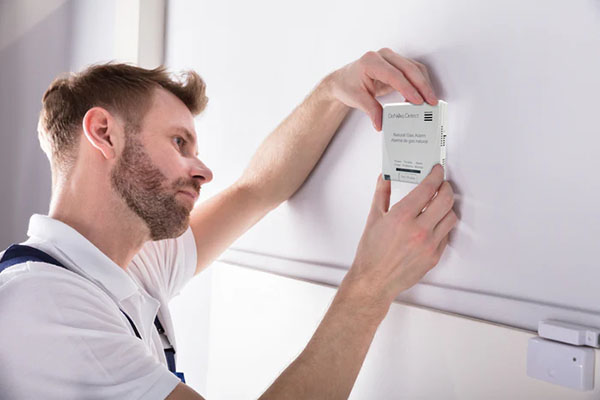
Buying a natural gas alarm for your home or business
Why Natural Gas Alarms Matter:
Natural gas is widely used in homes for cooking, heating, and hot water - but when a leak occurs, it can quickly become dangerous. Because natural gas is highly flammable and often odorless at low concentrations, leaks can go unnoticed until they reach explosive levels. A natural gas alarm in your home provides an essential early warning system, alerting occupants before conditions become life-threatening.
Installing a natural gas alarm adds a critical layer of protection beyond smoke and carbon monoxide detectors. It helps prevent fires, explosions, and serious property damage while giving families, tenants, and businesses the precious time needed to evacuate and contact emergency services. For any home with gas appliances, a dedicated natural gas detector is not just recommended - it's a key component of modern safety planning.
Why DeNova Detect Gas Alarms Are a Smart Choice:
DeNova Detect gas alarms are engineered to deliver faster, more reliable protection than traditional plug-in units. In fact, DeNova Detect is America's first and only 10-year battery-powered natural gas detector designed for long-term, maintenance-free safety. Each unit conforms to UL 1484 and uses gas sensors that meet UL 2075 standards, ensuring compliance with the most rigorous safety requirements. Unlike typical detectors, DeNova Detect operates without an outlet and never requires battery replacement - providing true "install it and forget it" peace of mind for homeowners, landlords, and property managers.
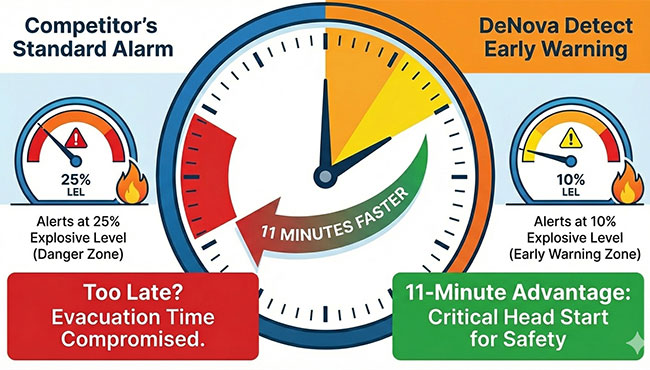
At the heart of every DeNova Detect alarm is advanced MEMS hot-wire semiconductor sensor technology. This cutting-edge sensor detects methane with greater precision and speed than conventional gas alarms, identifying explosive gas levels faster and giving occupants more time to respond. 11 minutes more escape time. Our low level natural gas alarm threshold of 10% LEL alerts to emergencies earlier on average than competitors' higher 25% LEL threshold (Validated by Fire & Risk Alliance).
DeNova Detect also stands apart with clear voice alerts in both English and Spanish, delivering life-saving instructions such as:
"Danger, gas leak — explosion risk. Evacuate, then call 9-1-1."
Powerful audio and LED indicators ensure warnings are heard and seen even in high-stress situations.
Equally important, DeNova Detect alarms are designed to produce virtually no false alarms. They are not affected by everyday household chemicals such as cleaners, sprays, or aerosols - a common weakness of many gas detectors. Built-in self-test diagnostics continuously monitor system health and notify users if any fault is detected, ensuring reliable performance over the entire 10-year lifespan.
Together, these features make DeNova Detect one of the most advanced and dependable natural gas alarm solutions available today.
Key Benefits of DeNova Detect Natural Gas Leak Detectors:
- 10-Year Battery Powered - no outlet or battery changes required.
- UL 1484 & UL 2075 Compliant — meets strict safety standards.
- MEMS Sensor Technology - faster, more precise methane detection.
- Virtually No False Alarms - resistant to household chemical interference.
- Voice Alerts (English & Spanish) - clear emergency instructions.
- Self-Test Diagnostics - continuous system monitoring.
- Powerful Speaker & LED Alerts - immediate, unmistakable warnings.
- Ideal for Homes, Rentals & Utilities - long-term, maintenance-free safety.
Buy A Natural Gas Alarm
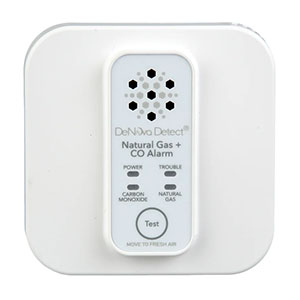
DeNova Detect 10-Year Battery-Powered Carbon Monoxide + Natural Gas Alarm
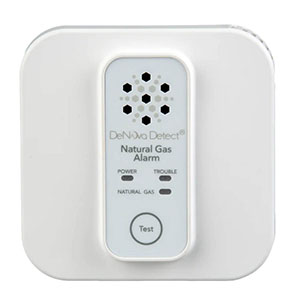
DeNova Detect 10-Year Battery-Powered Natural Gas Alarm
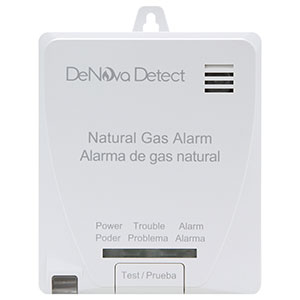
DeNova Detect 6-Year Battery-Powered Natural Gas Alarm
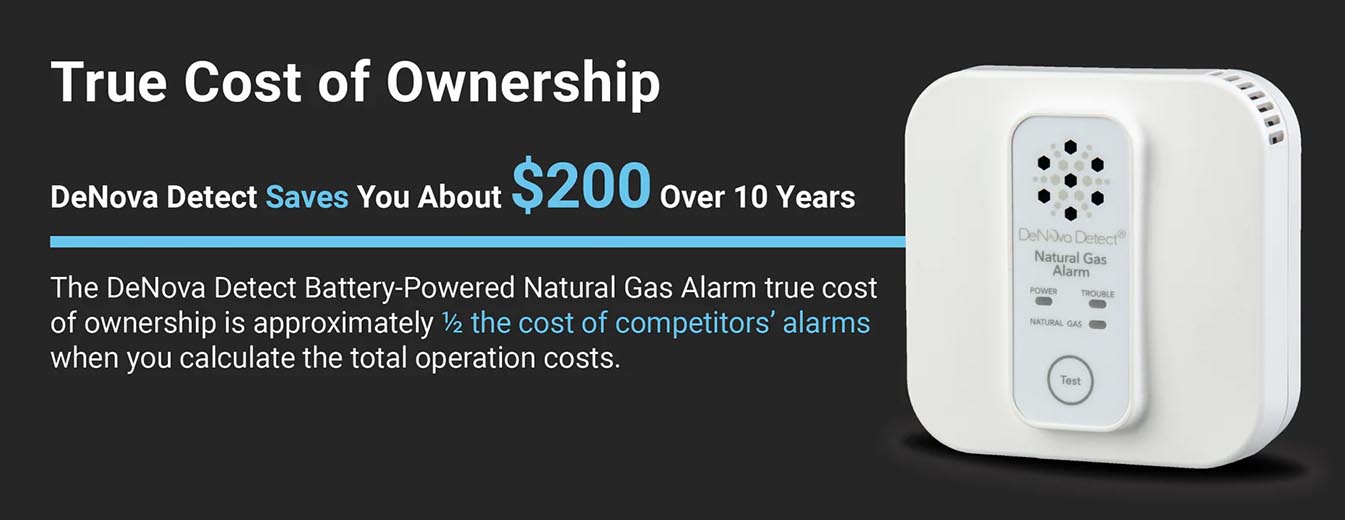
How to Choose the Best Natural Gas Detector for Your Home
Everything you need to know about LEL levels, battery power, and the new NFPA 715 safety standardsSelecting a natural gas detector isn’t just about price — it's about time. In a gas leak emergency, every second matters. The right detector can provide critical extra minutes for safe evacuation. When choosing protection for your home and family, focus on these four essential factors:
1. Battery vs. Plug-In Natural Gas Alarms
The most important factor is where the alarm can be placed. The Science: Natural gas is lighter than air and rises quickly toward the ceiling. The Smart Choice: Choose a 100% battery-powered natural gas alarm. Because it doesn’t rely on an outlet, it can be mounted within 12 inches of the ceiling - the true “danger zone” where gas accumulates first. Plug-in units are usually limited to outlet height near the floor, meaning they often won’t detect a leak until gas has already filled the room.
2. The New NFPA 715 Safety Standard
The NFPA 715 is the latest national safety standard for fuel gas detection devices released by the National Fire Protection Association. It is essentially the new "playbook" that treats natural gas alarms with the same level of importance as smoke and carbon monoxide detectors. It requires natural gas alarms to be mounted near the ceiling—exactly where gas accumulates. DeNova Detect was engineered specifically to meet and exceed NFPA 715 standards, offering 100% battery-powered ceiling mounting and an 11-minute faster response time than conventional units.
3. Natural Gas Alarms vs. Combination Alarms
Do you need to detect more than just natural gas? Natural Gas Only: Perfect for kitchens or laundry rooms where you already have a working smoke/CO detector. 2-in-1 Combination: If your current Carbon Monoxide (CO) detector is more than 5-7 years old, it's time for an upgrade. A Natural Gas and Carbon Monoxide Alarm saves outlet space and provides dual protection against the "Silent Killer" (CO) and explosive methane.
4. Maintenance and Longevity
Home safety should be "set it and forget it." Avoid Annual Hassles: Choose a unit with a 10-year sealed battery. This eliminates the need for annoying "low battery" chirps in the middle of the night and ensures the unit is always powered, even during a blackout. Compliance: Ensure your alarm meets the NFPA 715 standard, the latest national safety recommendation for residential gas detection.
10-Year Natural Gas and Carbon Monoxide Detector |
10-Year Battery-Powered Natural Gas Alarm Detector |
6-Year Battery-Powered Natural Gas Detector |
|
| Battery Life | 10 Years | 10 Years | 6 Years |
|---|---|---|---|
| Detection Type | Natural Gas (Methane), Carbon Monoxide (CO) | Natural Gas (Methane) | Natural Gas (Methane) |
| Detection Time | 10% LEL Gas Sensitivity, CO: 70ppm (60–240 min), 150ppm (10–50 min), 400ppm (4–15 min) | 10% LEL Gas Sensitivity | 10% LEL Gas Sensitivity |
| Voice Warnings | Carbon Monoxide, Natural Gas, Low Battery, Battery Error, End of Service Life | Natural Gas, Low Battery, Battery Error, End of Service Life | Natural Gas, Low Battery, Battery Error, End of Service Life |
| Detector Dimensions | 3.8" W x 3.8" H x 1.6" D | 3.8" W x 3.8" H x 1.6" D | 3.35" W x 3.94" H x 0.87" D |
| View More Info | View More Info | View More Info |
Where to install your natural gas detector
A natural gas detectors location is critical for early leak detectionNatural gas alarms should be installed in every room where a gas leak could occur or where a gas-powered appliance is located. This commonly includes kitchens (gas ranges and ovens), laundry rooms (gas dryers), and furnace or boiler areas. Because gas can travel along piping, installing natural gas detectors in multiple rooms throughout the home provides broader protection. For added safety, many homeowners also place a gas detector near bedrooms-especially if doors are closed while sleeping.
While natural gas detector placement should be located near potential leak sources, they should not be installed directly next to appliances. To reduce false alarms and ensure accurate detection, place the alarm 3–10 feet away from gas appliances and within 12 inches of the ceiling, since natural gas is lighter than air and rises. Avoid placing alarms close to cooking appliances or range hoods; if no other option exists, keep them at least 5 feet away to prevent contamination from grease and cooking vapors.
Correct placement also means avoiding areas that could interfere with performance. Alarms should not be installed near doors, windows, vents, HVAC returns, moisture sources, or in spaces that are excessively hot, cold, dusty, or humid. These conditions can prevent the sensor from working properly and reduce the effectiveness of the alarm. This placement strategy ensures your natural gas alarm performs accurately, avoids nuisance alerts, and provides the earliest possible warning if a leak occurs.
Recommended gas detector placement:
- Within 12 inches of the ceiling.
- 3–10 feet from gas appliances.
- At least 5 feet from cooking appliances or range hoods.
- In an open area where airflow is not blocked by curtains, fans, or fixtures.
NOT Recommended:
- In cathedral ceiling peaks.
- Near water sources (sinks, dishwashers, showers).
- Next to doors, windows, ventilation fans, or HVAC ducts.
- In damp, humid, dusty, or dirty areas.