

Natural Gas Alarm Buying Guide
Learn how to choose the best natural gas alarm for your home. Compare detector types, placement, sensor technology, and key safety features.
Related Topics:
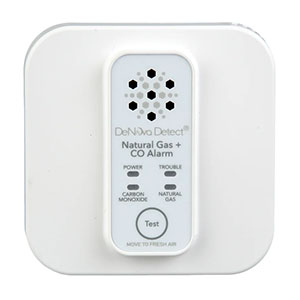
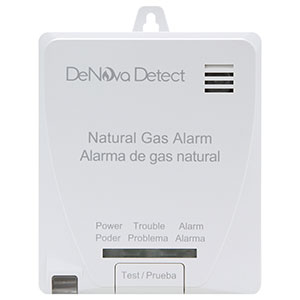
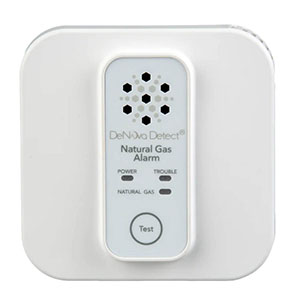
While plug-in alarms are common, they carry a hidden risk: Gravity.
Natural gas (methane) is half the weight of air. When a leak occurs, it rushes toward the ceiling immediately.
Since most electrical outlets are near the floor, a plug-in alarm is often the last device to sense the danger. Battery powered units can be mounted in the "danger zone", the upper 12 in. of a room where gas actually collects.
| Key Features | Standard Plug-In Alarms | DeNova Battery Alarms |
|---|---|---|
| Mounting Placement | Restricted to outlets (Near Floor) | Precision Placement (Near Ceiling) |
| Safety Standards | ✕ Fails NFPA 715 Rules | ✓ Fully NFPA 715 Compliant |
| Power Outages | Fails without specific backup | "Always-On" 10-Year Battery |
| Home Aesthetics | Visible cords & used-up outlets | Wireless "Set-and-Forget" Profile |
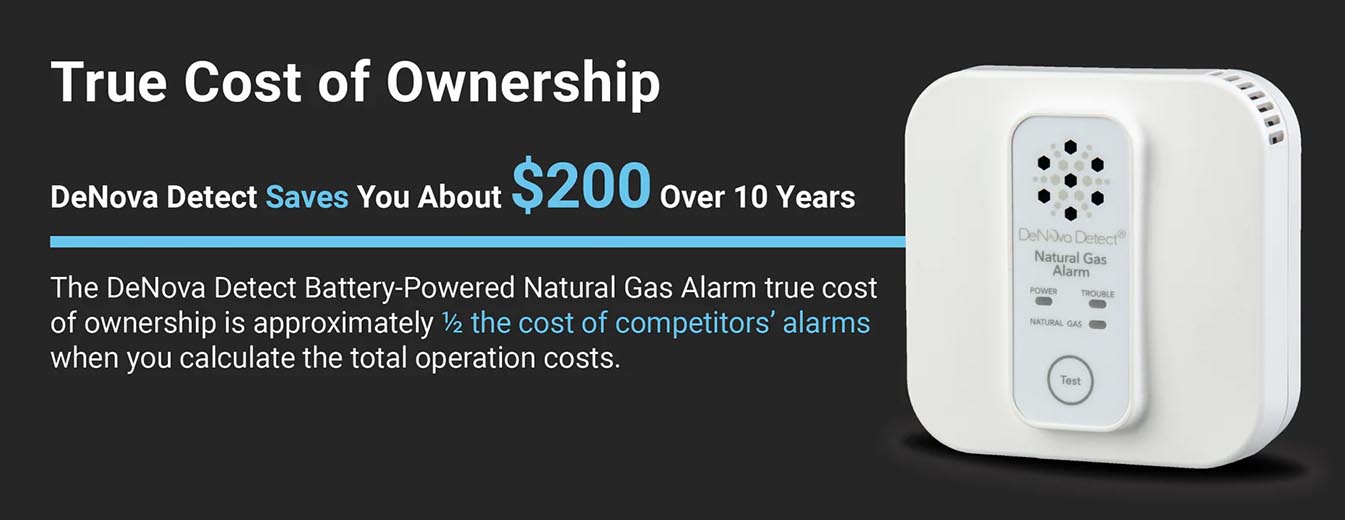
Battery-powered natural gas alarms with sealed lithium batteries are designed to last for the full life of the sensor, typically up to 10 years. This "set it and forget it" approach eliminates routine battery changes and the nuisance of low-battery chirps.
In contrast, plug-in models often require replacing 9-volt backup batteries every six months, increasing maintenance and the risk that the alarm may not be powered when needed.
Since methane rises so rapidly, a sensor located at outlet level (near the floor) may not trigger until the entire room has significantly filled with gas. Research suggests that high-mounted battery alarms can provide up to an 11-minute head start on evacuation compared to traditional lower-mounted plug-in sensors. In a combustible gas situation, those 11 minutes are the difference between a safe exit and a catastrophe.
Plug-in natural gas alarms may be used in limited situations where high-wall placement is not possible or where outlets are already located near the ceiling. However, these scenarios are uncommon in most residential homes.
For the vast majority of homeowners, renters, and landlords, battery-powered alarms provide better placement flexibility and more reliable protection.
Plug-in alarms seem budget-friendly, but hidden costs add up over a ten-year lifespan. Between annual 9V battery replacements, continuous electricity draw, and the potential $150+ cost of moving outlets to meet safety standards, "cheaper" units become expensive liabilities.
In contrast, the DeNova Detect 10-year battery alarm uses high efficiency MEMS technology and a long-life lithium cell. By eliminating annual maintenance and energy bills, this "set-and-forget" solution pays for itself while providing superior safety.
Choose Plug-In if: You have an eye-level outlet specifically installed for safety devices (rare in most homes) and a reliable battery backup.
Choose Battery-Powered if: You want to follow NFPA 715 standards, which recommend mounting detectors high on the wall to account for natural gas buoyancy.
Explore related support articles and resources for this topic.
Learn how to choose the best natural gas alarm for your home. Compare detector types, placement, sensor technology, and key safety features.
Contact options may differ depending on the type of help you need.