

Guide to Natural Gas Alarm Safety
Learn how natural gas detectors work, where to install them, and how to protect your home from methane leaks with fast, reliable gas alarm safety guidance.
Related Topics:
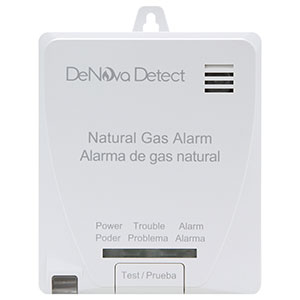
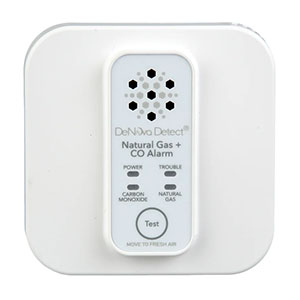


A natural gas detector is designed to identify methane in the air before it reaches a dangerous or explosive level. Unlike smoke or carbon monoxide alarms, natural gas detectors rely on specialized sensor technology that reacts specifically to unburned gas.
A natural gas alarm detects leaks by sensing the physical or chemical presence of methane molecules in the air. Methane is highly flammable and lighter than air, which means it rises quickly toward the ceiling and can accumulate without being immediately noticed.
To detect these leaks early, natural gas detectors use sensors that respond when methane reaches a measurable concentration. Once detected, the alarm triggers audible and visual warnings to alert occupants to evacuate and contact emergency services.
Older or conventional natural gas detectors typically use catalytic bead sensors. These sensors work by burning a very small amount of gas on a heated element and measuring the resulting change in electrical resistance.
While effective, catalytic sensors can respond more slowly and may be more prone to false alarms from household chemicals, humidity, or contaminants over time.
Step 1: Continuous Sampling
Step 2: Intelligent Analysis
Step 3: Critical Verification
Step 4: Instant Alert
Modern devices, such as the DeNova Detect natural gas detector, utilize advanced MEMS (Micro-Electro-Mechanical Systems) technology. This approach allows for faster, more precise detection compared to traditional sensors.
A MEMS-based natural gas leak detector works by drawing methane molecules onto a precision-engineered silicon chip. When natural gas is present, the chip generates a rapid electrical signal even at very low concentrations, triggering an alert much earlier in the leak process.
This high sensitivity allows the detector to alarm at just 10% of the Lower Explosive Limit (LEL), providing valuable extra time to respond before natural gas reaches a dangerous level.
The Lower Explosive Limit (LEL) is the minimum concentration of natural gas in the air required for a spark to cause an explosion; for methane, this threshold is reached at 5% of the total air volume. When a detector is rated for 10% LEL, it is designed to trigger an alarm when the gas concentration reaches just one-tenth of that explosive level. This provides a critical "Safety Margin," alerting you to a leak long before the environment becomes combustible. While many standard alarms don't activate until 25% LEL, a 10% LEL threshold offers those vital extra minutes to evacuate and call emergency services while the gas levels are still well within a manageable range.
Traditional sensors are power-hungry and often triggered by "nuisance" household smells like cleaning sprays. MEMS (Micro-Electro-Mechanical Systems) technology uses advanced silicon chips that are far more selective, ignoring background odors to focus exclusively on methane. This extreme efficiency is what allows for a 10-year battery life, providing uninterrupted protection during power outages when traditional plug-in alarms fail. By switching to MEMS, you get higher precision and a maintenance-free life-safety solution.
Since natural gas rises toward the ceiling, early detection is critical. A highly sensitive home natural gas detector can identify rising natural gas near the ceiling much faster than older, less efficient sensors that may not alarm until gas levels are significantly higher.
Earlier alerts mean more time to evacuate safely, avoid ignition sources, and call 9-1-1 or your gas utility.
Some advanced devices are designed to monitor more than one type of gas. A 2-in-1 natural gas and carbon monoxide detector provides the specialized technology needed to monitor both explosive methane leaks and toxic carbon monoxide in a single device.
These combination detectors use separate sensing technologies for each hazard, ensuring accurate detection without compromising safety.
A 10-year sealed lithium battery is more than just a convenience; it is a direct result of advanced engineering. Traditional natural gas sensors are "power-hungry" components that typically require a wall plug to maintain the high temperatures needed for detection. However, because MEMS technology is incredibly energy-efficient, it allows for a decade of continuous monitoring on a single battery. This technical milestone ensures uninterrupted protection during power outages—a critical window of vulnerability when traditional plug-in alarms go dark and homeowners might be relighting pilot lights or using backup generators.
A natural gas detector works by sensing methane molecules in the air using specialized sensor technology. Modern MEMS-based detectors offer faster alerts, fewer false alarms, and earlier warnings at low natural gas concentrations. Choosing a high quality methane gas alarm ensures reliable protection against explosive natural gas leaks in your home.
Explore related support articles and resources for this topic.
Learn how natural gas detectors work, where to install them, and how to protect your home from methane leaks with fast, reliable gas alarm safety guidance.
Contact options may differ depending on the type of help you need.